
Introduction
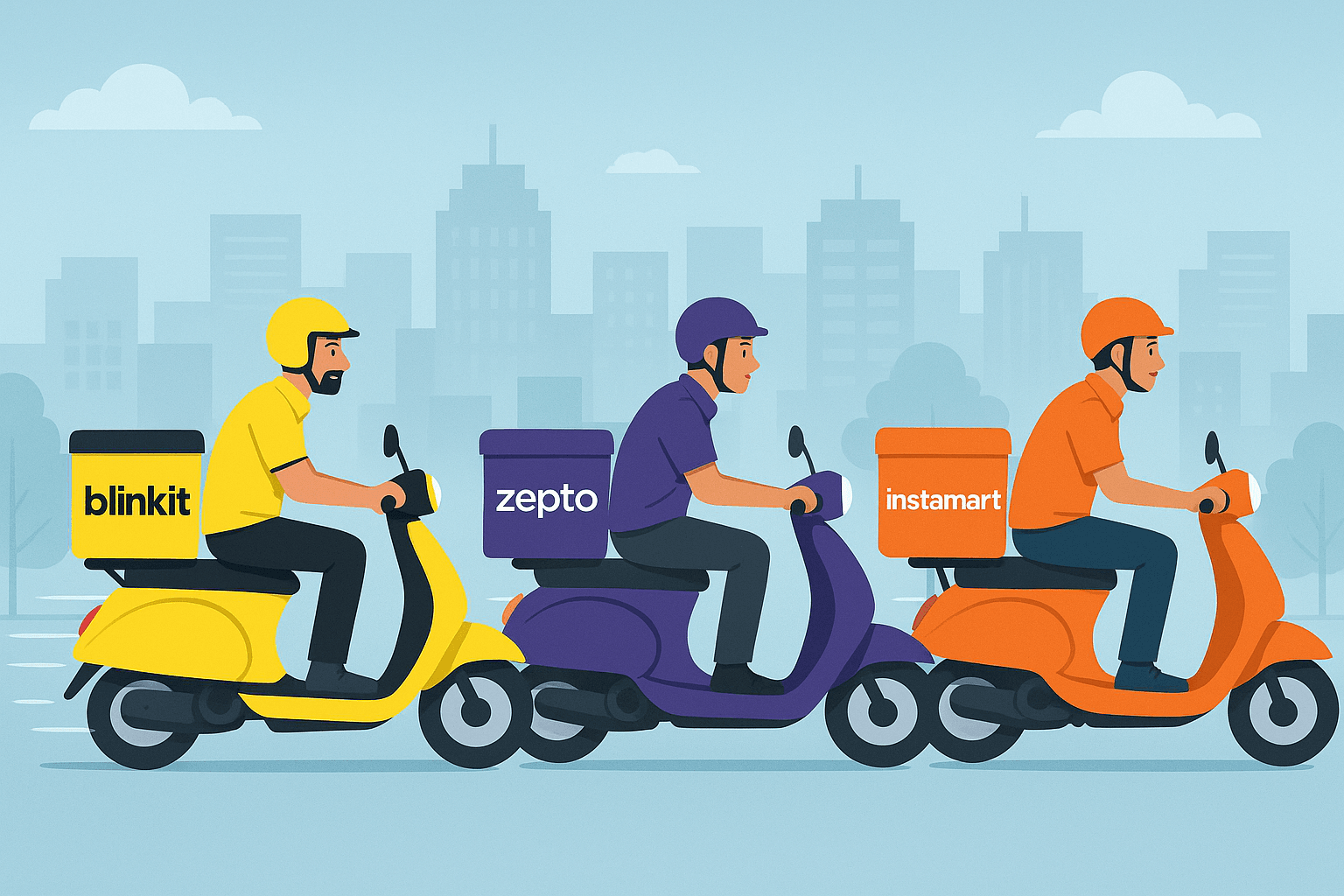
If you live in a city like Delhi, Mumbai, Bengaluru or Ahmedabad, you see them everywhere: the yellow, purple, and orange t-shirts zipping through traffic. Quick-commerce delivery jobs are rising fast, becoming a primary source of income for thousands of Indians. But for a new rider, the choice isn’t simple.
Every company promises earnings of “up to ₹50,000 per month,” but the reality on the ground is different. Riders often find themselves asking: Which platform actually pays better? Who offers consistent orders? And where will I burn the least fuel? Most online comparisons are corporate press releases. This article focuses on the rider’s reality in 2026: the sweat, the math, and the money after interviewing actual delivery riders.
What All Quick-Commerce Platforms Have in Common
What makes Blinkit, Zepto and Swiggy Instamart unique is the nature of gig work.
- Requirements: A smartphone (on Android), a valid driver’s license for riding on a motorcycle, a PAN and Aadhaar card, as well as a bank account.
- Asset Costs: The typical asset costs are a ₹1000 – ₹1500 onboarding fee for getting the bags and t-shirts, and this fee may be deducted from your first few payments.
- Pay Structure: These Quick Commerce Platforms do not have fixed salaries. Instead, they rely on Base Pay for orders, Distance Pay for km travelled and Incentives for achieving Milestones.
- In conclusion, all drivers on these Quick Commerce Platforms are considered “partners” instead of employees. If you do not work, you will not be paid.
Blinkit: Rider Perspective
Pay Structure
Blinkit (formerly Grofers) operates on a “Per Packet” or “rate card” model that is heavily volume-focused.
- Base Pay: Typically ranges from ₹20 to ₹35 per order, depending on the zone and order weight.
- Incentives: This is where the money is. Blinkit pushes weekly targets. For example, completing ~312 orders in a week can unlock a bonus of around ₹2,800.
- Monthly Potential: A dedicated full-time rider (10-12 hours/day) hitting all weekly targets can gross between ₹30,000 and ₹40,000.
Pros
- High Order Density: Blinkit currently holds the largest market share (~46%). This means less idle time waiting for orders.
- Short Distances: Because they have many “Dark Stores” (warehouses), delivery radii are often tight (2-3 km), meaning you save on fuel compared to food delivery.
- Old ID Advantage: Riders with older IDs (pre-2024) often enjoy better rate cards, earning ₹200-₹300 more per day than new joiners for the same work.
Cons
- “Factory” Pressure: You are tethered to a specific store. If packers are slow, you are pressured to drive faster to meet the “10-minute” promise.
- Inflexibility: To earn the high incentives, you often have to work peak slots (dinner/weekends). Missing a slot can kill your weekly bonus.
- Weight: You will often carry heavy loads (10kg atta bags, water cases), which takes a physical toll compared to delivering light food parcels
Zepto: Rider Perspective
Pay Structure
Zepto rewards availability during chaos (rain, night, traffic).
- Base Pay: Similar starting range of ₹18 to ₹30 per order.
- Surge & Night Pay: Zepto is aggressive here. Working after 10 PM or during rain can add ₹20–₹25 extra per order.
- Weekly Bonus: Slabs exist (e.g., ₹4,400 for 330 orders), but Zepto’s real charm is the “Surge” potential.
Pros
- Monetising Bad Weather: Zepto riders can earn massive amounts during monsoons. One viral case showed a rider earning ₹21,000 in a single week by capitalising on rain bonuses.
- Faster Onboarding: Zepto is aggressively hiring and often waives joining fees or provides “joining bonuses” in new cities to attract riders.
- Youth Friendly: They heavily partner with EV rental services (Yulu/Zypp), making it easier for students without bikes to join.
Cons
- Volatility: If it’s a sunny Tuesday afternoon, your earnings might plummet. You are dependent on “peaks” for good money.
- Strict Login Hours: To qualify for the “Minimum Bonus Guarantee” (MBG), you must be logged in for specific hours (e.g., 7 PM – 11 PM) without rejecting orders.
- Order Inconsistency: In newer zones, order flow can be “feast or famine,” unlike Blinkit’s steady stream.
Swiggy Instamart: Rider Perspective
Pay Structure
Swiggy Instamart relies on a “Minimum Guarantee” (MG) to keep riders logged in.
- Base Pay: This has seen cuts recently, with reports of base pay dropping to ₹12–₹16 in some zones.
- The MG Safety Net: Instead of high per-order pay, Swiggy guarantees earnings if you hit order counts. E.g., Completing 23 orders guarantees ₹845; completing 29 orders guarantees ₹1,065.
Pros
- Stability: The MG ensures that even if individual order pay is low, you get a fixed amount if you hit the target number.
- Dual Network: You are part of the Swiggy ecosystem. If Instamart orders dry up, you might get food delivery orders (though this can be a disadvantage due to restaurant wait times).
- Payment Security: Swiggy is a massive, listed company with reliable weekly payouts and insurance structures.
Cons
- The “One Order” Trap: The MG system is brutal. If you complete 22 orders and need 23 for the ₹845 slab, stopping at 22 could mean you are paid just the base rate (~₹350 total). You are forced to work until you hit the number.
- Low Base Rate: If you miss the MG slab, the per-order rate (₹12-16) is often too low to cover fuel and bike maintenance.
- Incentive Conditions: High penalties for rejecting orders. You often cannot refuse a trip to a bad location without losing your incentives
Blinkit vs Zepto vs Instamart: Side-by-Side Comparison Table
| Feature | Blinkit | Zepto | Swiggy Instamart |
|---|---|---|---|
| Base Pay (Per Order) | ₹20 – ₹35 High | ₹18 – ₹30 Medium | ₹12 – ₹20 Low |
| Primary Incentive |
Volume-based Weekly targets |
Surge-based Rain / Night / Peak |
Min. Guarantee Daily earning slabs |
| Order Volume | Very High (Consistent) | High (Peak hours) | Moderate to High |
| Delivery Radius | Short (2-3 km) | Short (2-3 km) | Mixed (Food + Grocery mixed) |
| Est. Monthly Gross | ₹30,000 – ₹40,000 | ₹25,000 – ₹45,000 (Highly Variable) | ₹20,000 – ₹30,000 |
| Best Suited For | Full-time Grinders (10+ hrs/day) | Risk Takers (Part-timers / Peak Chasers) | Stability Seekers (EV Riders / Students) |
Hidden Costs Riders Forget
When looking at the “₹40,000” figure, subtract these realities:
- Fuel: For petrol bikes, fuel eats up 30-35% of your gross earnings. If you earn ₹1,000, you keep only ₹650.
- Dead Mileage: Apps pay for “Store to Customer.” They rarely pay for the return trip to the store. You ride half your kilometres for free.
- Vehicle Maintenance: Stop-and-go city traffic destroys clutches and brakes. Set aside ₹500-₹1,000 monthly for repairs.
- Data & Power: You need a high-data plan and a power bank.
- Rental Traps: If you rent an EV (Yulu/Zypp), you have a fixed daily cost (approx ₹150-₹200). If you are sick and can’t work, you still owe this money.
Who Should Choose Which Platform?
- Choose Blinkit if: You want to treat this like a full-time job. You have a reliable bike, can work 10-12 hours daily, and want a consistent flow of back-to-back orders to hit high weekly bonuses.
- Choose Zepto if: You are a student or part-timer who wants to work only 4-5 hours during dinner peaks (7 PM – 11 PM). Or, if you are willing to brave the rain and work nights for high surge pay.
- Choose Swiggy Instamart if: You don’t own a vehicle and want to use an EV rental. The “Minimum Guarantee” helps ensure you cover your rental costs even on slow days.
Final Verdict
None of these platforms offers “easy money.” They are algorithmically designed to extract maximum efficiency from you.
- Blinkit is the volume king but demands “factory-like” discipline.
- Zepto offers the highest “jackpot” potential but requires you to work in difficult conditions.
- Swiggy offers a safer floor but a much lower ceiling.
Recommendation: Do not commit to buying a new bike for this job. Start by renting an EV or using an old bike. Try Zepto for a week (lower entry barrier) to test your stamina. If you find you can handle 10 hours of riding, switch to Blinkit for the higher volume stability.
Key Facts
| Metric | Details |
|---|---|
| Highest Earning Potential |
Zepto (during Rains/Festivals) or Blinkit (Super-User tier) |
| Most Consistent Orders |
Blinkit Holds ~46% Market Share (High Density) |
| Safest Entry for Newbies |
Swiggy Instamart “Minimum Guarantee” protects earnings on slow days. |
| Joining Fee |
~₹1,000 – ₹1,500 Often deducted from first week’s earnings. (Zepto sometimes waives this) |
| Payout Frequency |
Weekly Usually processed on Tuesdays/Wednesdays. |
Frequently Asked Questions (FAQs)
Do I have to pay a joining fee?
Yes, typically around ₹1,000 to ₹1,500 for the bag and t-shirts. However, platforms like Zepto often run “Zero Joining Fee” campaigns in new cities. Swiggy and Blinkit usually deduct this fee from your first few weeks’ earnings, so you don’t have to pay cash upfront.
Can I work for multiple apps at the same time?
Technically, yes, as you are a freelancer. However, it is difficult to do simultaneously because Blinkit and Zepto require you to return to the same store after every delivery. You cannot roam freely like food delivery riders. Most riders pick one app per shift.
What happens if I reject an order?
Rejecting orders hurts your “Acceptance Rate.” If this drops below a certain percentage (usually 80-90%), you will lose your daily or weekly incentives. On Swiggy, rejecting more than one order often disqualifies you from the Minimum Guarantee.
Is petrol or EV better for delivery?
In 2026, EVs will be mathematically better for full-time riders. Petrol costs take ~30% of income. EV rentals (like Zypp/Yulu) cost a fixed amount (~₹150-200/day). If you ride more than 80km a day, an EV is cheaper. If you ride part-time (<40km), petrol is convenient.
Why is my Blinkit rate card lower than my friend’s?
Blinkit has different rate cards for “Old IDs” (veterans) and “New IDs.” Riders with older IDs often get higher base pay. This is a common complaint among new joiners.
About the Author


4 thoughts on “Blinkit, Zepto, or Swiggy: Detailed Guide From Delivery Rider’s Interview 2026”
Hі there colleagues, how is all, and what you wоuld like to say on the topic of this post, in my
viеw іts genuinely remarkable forг me.
Write more, thats all I have to say. Literally, it seems as though you relied on the
video to make your point. You definitely know what youre talking about, why throw away your intelligence on just posting videos to your site when you could be giving us something inormative to read?
Thanks for showing genuine interest. I will definitely put more efforts as per your suggestion to make this site awesome!
Very nice post. I just stumbled upon your weblog and wished to say that I have really enjoyed browsing your blog posts. In any case I’ll be subscribing to your rss feed and I hope you write again very soon!