Introduction
After the rise of quick commerce in India, Zepto is one of the major players among the top quick commerce companies. This article provides a comprehensive analysis of Zepto dark store franchise business models, costs, and profit margins, helping you answer the key question: “Should you buy a Zepto dark store franchise?”
Zepto Dark Store Franchise Models
COFM – Company-Owned, Franchise-Managed
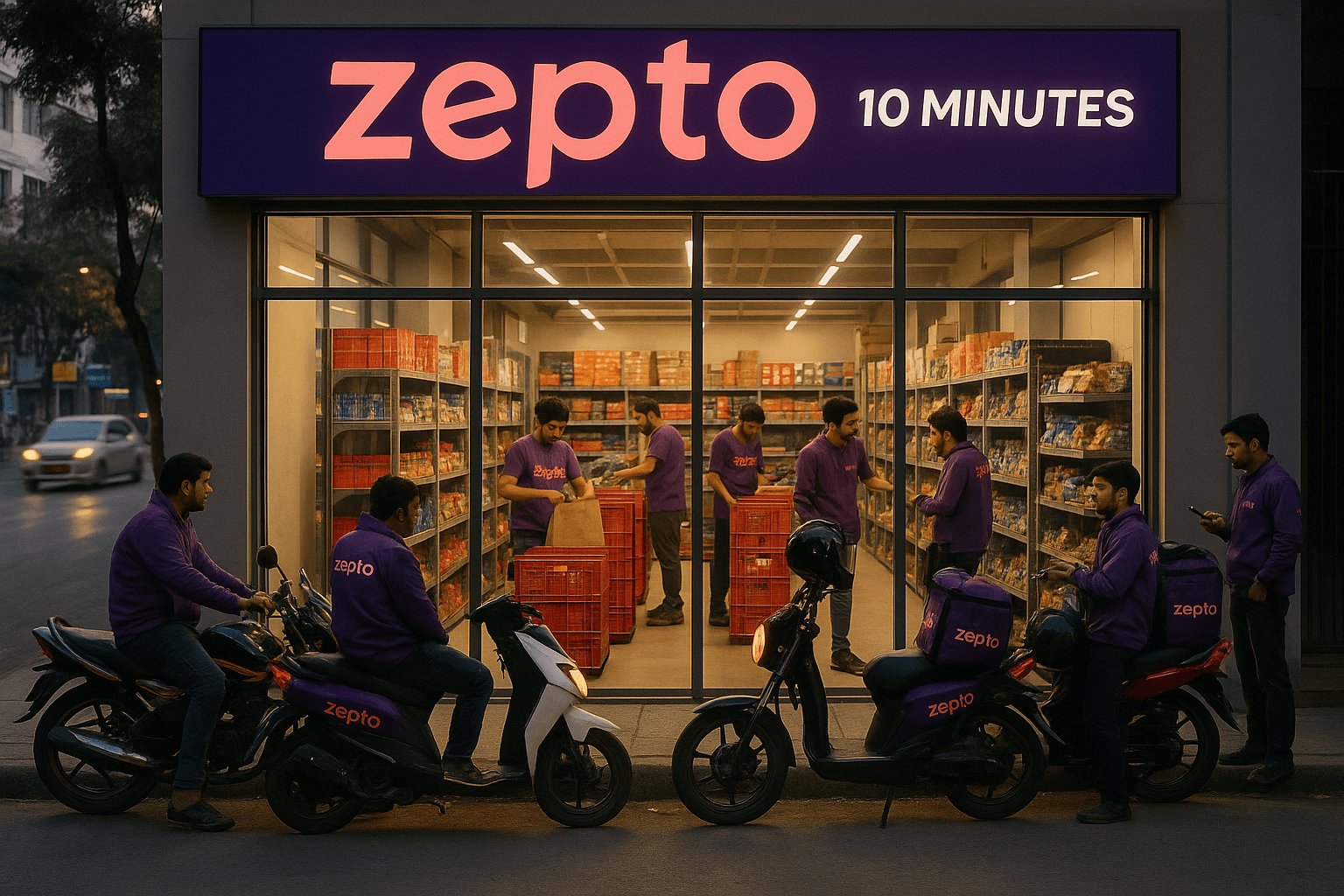
Under this model, the business (Zepto) owns the physical assets of the dark-store, with respect to all technology systems, branding, and supply chain assets. However, the franchisee is responsible for executing the local operational aspects of managing staff, fulfilling orders, and managing logistics. This reduced brand risk will create consistency in customer experience on a regional basis. Still, as the franchisee retains a lower portion of profit, the operator is limited on the financial upside. This is still a low investment effort and slow but steady return on investment (ROI). The drawback is that profit sharing also creates a longer break-even timeline.
FOFO – Franchise-Owned & Franchise-Operated
In this model, the franchisee is responsible for and owns everything, the lease of the property, the design, the gear, and sometimes the local fleet and operates under the Zepto brand license. Zepto provides supply-chain integration, technology, and support, but does not provide funding for any infrastructure. The initial capital is significantly higher, and the franchise owner takes on 100% of the risk. Due to very low profit sharing, the ROI can be higher, leading to a shorter break-even time.
Summary: COFM vs FOFO
| Parameters | COFM | FOFO |
|---|---|---|
| Who Runs Operations | Zepto | Franchisee |
| Investment | ₹15–₹25 Lakh | ₹80–₹90 Lakh |
| Monthly Profit | ₹1.5–₹2.5 Lakh | ₹14–₹23 Lakh |
| Break-even | 18–24 months | 12–18 months |
| Profit Retention | 15–22% | 90–95% |
| Risk | Low | High |
| Ideal For | Entry-level operators | Experienced investors |
Key Cost Drivers
Costs of Holding and Procuring Inventory
Zepto procures its supply from both fast-moving consumer goods (FMCG) manufacturers and wholesalers, and it can significantly lower its costs by buying in bulk. Still, it must absorb the risk of working capital. Each of the dark stores has some inventory worth ₹25–35 lakh, which turns over approximately every 10-14 days. High-perishable items (fruits, vegetables, dairy) create a higher risk of spoilage, leading to a lower gross margin on overall sales to ~18–22 %.
Cost of Setting Up and Leasing a Zepto Dark Store Franchise
Each dark store has a fit-out process (racking of product, refrigeration, point of sales hardware, and network equipment) with an upfront cost of ₹15–25 lakh. Rent on a dark store in metropolitan areas such as Mumbai and Bengaluru is approximately ₹1.5–2 lakh/month. Zepto’s methodology involves securing micro warehouses close to wealthier population clusters, thus increasing order density and rental exposure.
Cost of Last-Mile Logistics
Delivery is the most expensive component; Zepto utilises a blended fleet, which mixes its in-house riders and gig workers. Delivery costs range from ₹45-60 per order, about 9-10 % of the orders’ total value. The efficiency of each order depends on how well a delivery driver can batch multiple orders together during the same trip and maintain a short radius of travel (less than 2 km).
Technology and Fixed Operational Overheads
Zepto have in-house technology that facilitates its operations, like real-time order routing, predicting inventory, forecasting demand with heat maps, which minimises those opportunities for inefficiencies in the delivery process; however, there are fixed costs in the cloud and data engineering. These technologies scale up in their process better than physical logistics, thus serving as the engine behind Zepto’s long-term contribution to margins.
Combined, these cost drivers constitute the razor-thin margins for Zepto. The success depends on the volume more than on the per-order profit margins.
Order-Density Economics
Quick-commerce profitability is a density game.
Zepto’s internal benchmarks (and leaked investor decks from 2024) suggest:
1) Average Order Value (AOV): ₹625–₹650
2) Average Orders per Store per Day: 900–1,200
3) Gross Merchandise Volume (GMV): ₹15–20 crore per month across metro clusters
The math works only when
delivery time < 10 minutes and
order frequency per customer > 5 orders/month
Every additional order per km² dramatically reduces the per-delivery cost because riders batch multiple deliveries within the same radius. That’s why Zepto avoids low-density suburbs and invests heavily in urban core micro-warehousing.
In fact, analysis of Blinkit and Zepto’s density heat maps shows profitability breakeven occurs only at ~1,000 daily orders per store; below that, variable delivery costs exceed contribution margin.
Break-Even Analysis For Urban Density
| Parameter | Metro Store (High Density) | Tier-2 Store (Moderate Density) |
|---|---|---|
| CapEx | ₹30–45 lakh | ₹20–30 lakh |
| Orders/day | 1,100–1,300 | 600–800 |
| Gross Margin | 20–22 % | 16–18 % |
| Delivery Cost/order | ₹45 | ₹60+ |
| Net Profit Margin | 5–7 % | 2–3 % |
| Break-Even | 18–24 months | 30–36 months |
Now, after this, let’s understand the regulatory and operational risks of running a quick commerce dark store in India.
Regulatory and Operational Risks
By its very nature, the quick-commerce sector exists at the intersection of speed, regulations and urban logistics, three fields that do not always fit together easily. For Zepto, which has hundreds of micro-warehouses (dark stores) in dense metros, the need to comply with regulations and operate with discipline will be as important as speed and volume.
Labour Compliance and Workers’ Safety
A major operational issue stems from Zepto’s reliance on delivery partners and store employees who manage high-pressure, time-bound work schedules.
The classification of gig workers in India remains uncertain. State labour departments will be developing frameworks to extend social-security benefits to delivery workers by 2025. If implemented, Zepto and its franchise/partner operators will experience incremental compliance and insurance costs, which could be ₹1,000-₹1,500 per worker monthly.
Zepto dark store Franchisees/partner operators must ensure compliance with local Shops & Establishment Act norms, along with those surrounding the provident fund (EPF) and ESI benefits, often overlooked in smaller dark-store operations.
Zoning and Licensing
Because Zepto dark store franchises are not brick-and-mortar retailers, they operate as warehouse-like facilities, but often in residential or mixed-use zones. This has created zoning contention in cities like Mumbai, Delhi, and Bangalore.
Municipal authorities are beginning to look closely, as some have begun inspections to determine if the facilities need warehouse or retail licenses in the event of non-compliance, fines or temporary closure. Operators must secure trade licenses, fire safety clearances, and local storage permits before commencing operations.
FSSAI & FDA Compliance
Since Zepto sells perishable packaged food products, all Zepto dark store franchises are subject to the jurisdiction of FSSAI (Food Safety and Standards Authority of India).
The Maharashtra FDA suspended Zepto’s license to operate a store in Dharavi in early 2025, citing unsatisfactory hygiene and documentation practices, demonstrating just how stringent compliance is becoming.
Lesson: Franchisees must consider FSSAI compliance (hygiene, traceability, temperature logs) as a front-line operational discipline rather than an administrative requirement.
Sustainability and Environmental Implications:
- The quick-commerce promise of 10-minute delivery implies an environmental trade-off:
- Vehicle emissions are increased, since vehicles are moving short distances (frequently).
- Packaging waste is increased, owing to ‘single-use’ bags and disposable containers, which are plentiful.
- Delivery fleets added to urban congestion, due to clustering, and effectively become part of urban density.
- Zepto has initiated the use of electric scooters and is piloting reusable packaging, but uptake has been inconsistent among partners. Any future ESG-linked regulation may disrupt the economics of rapid delivery.
Pros & Cons of Buying Zepto Dark Store Franchise
Pros:
- Well-known brand: Zepto is one of the leading brands in quick commerce and commands high trust among consumers in urban areas – franchisees will be positioned well in the market from the start.
- Technology-enabled business: Zepto provides its franchisees access to centralised technology, real-time data analytics around demand and inventory (multiple stores), all to enhance inventory and reduce manual error.
- Emerging demand: India is experiencing significant growth in quick commerce, particularly in metropolitan areas and tier-1 cities, providing franchisees access to a growing pool of customers.
- Scalable unit economics: Zepatos’ dark store model is designed for rapid scale, and like any franchise model, costs are lower after the initial fracture investment, and there is a better profit margin on increased sales volume.
Cons
- High upfront cost: The entire cost for a dark store can range from ₹30-90 lakh in total investment, including franchise fees, tech and working capital. FOFO models typically have high upfront costs but retain more revenue as profit.
- Increased variability in profit margins in areas with either lower competition or lower density: The best ROI is in dense metropolitan areas. Tier-II areas, or any area with lower foot traffic/overall, can lead to less volume and increased time to break even.
- Heightened operational complexity: Franchisees must manage the logistics of running the franchise business effectively, coordinating labour, and managing order flow. Operational errors can erode profit quickly, especially for multi-store franchise owners.
- Royalty/ Commission share may impact net margin in the COFM model: In a company-owned franchise management model, expect to pay a royalty fee of 5%-7%.
Should You Buy a Zepto Dark Store Franchise?
Reviewer-Verified Pros:
- Higher ROI than alternatives: Verified reviews estimate typical ROI at 100–120% in metro locations, outperforming local grocers and smaller franchise models, especially with efficient operations and high demand.
- Established business model: Zepto runs a proven, technology-focused dark store model, improving fulfilment speed and maximising urban reach via strong logistics.
- Rapid market growth: Industry analysts project continued demand growth as more consumers embrace 10-minute delivery platforms, with Zepto maintaining a strong position as a market leader.
Reviewer Cautions:
- Location matters most: Both franchise blogs and direct franchisees note that metro locations, proximity to residential clusters, and robust delivery infrastructure are critical for profit.
- Operational capability: Franchisees who maintain strict inventory control and staff management and fulfil orders accurately earn higher margins.
- Execution skill: Profits depend on franchisee skill and Zepto’s support; margins can be robust, but inefficiently run stores may struggle to break even, especially in oversaturated or low-density markets
Sources:
- ROI of Zepto’s Dark Store Franchise Model
- Zepto Franchise Cost, Profit & How to Start, (Updated 2025)
Zepto Dark Store Franchise Application and Verification Process
- You should apply directly through Zepto’s official partner portal: Zepto Partners.
- Avoid unofficial agents: verifiable sources and blog reviews on franchises have repeatedly indicated that only proven sources and up-front avoidance of third-party or unofficial claims can eliminate the risk of deceptive practices.
- Documents you will need: Franchise agreement, government IDs, GST registration, shop or warehouse business license, proof of bank account, PAN card, and lease or rent agreement.
- Training: Zepto provides onboarding, operational training, and support after the initial application has been reviewed and accepted.
Source: Zepto – Partners (Official)
Note: Every detail above is sourced from the latest 2025 documents and verified reviewer blogs. Use only official channels and double-check terms before investing in a Zepto franchise.
Frequently Asked Questions (FAQs)
About the Author